
How to Choose a Linear Actuator: Load, Stroke, Speed and Duty Cycle
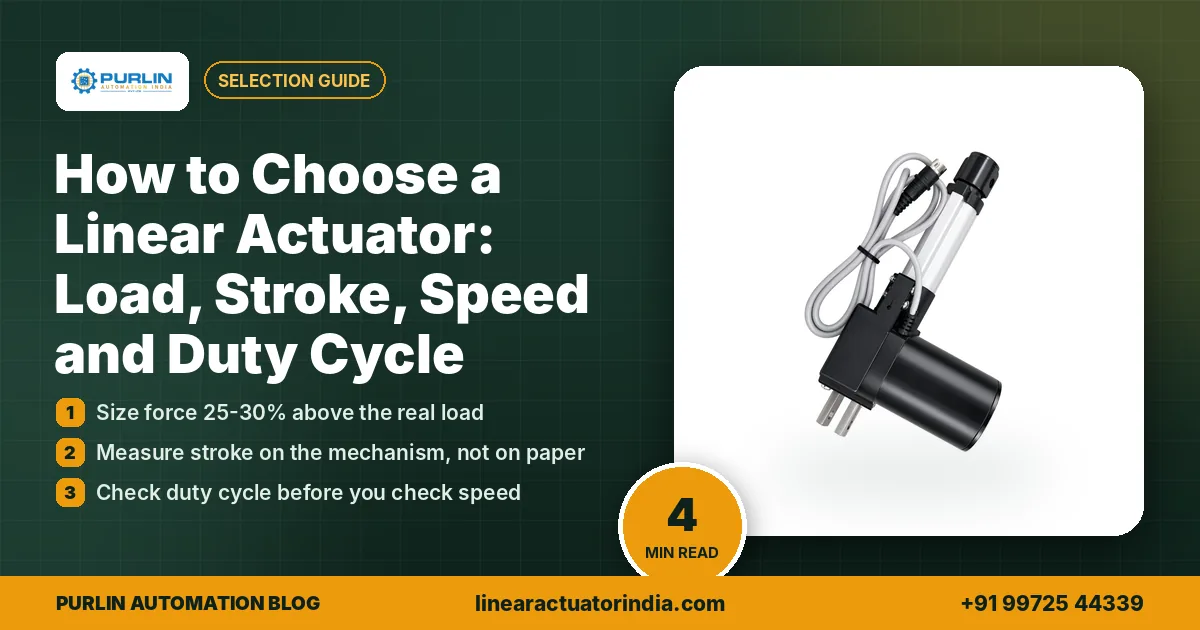
Most actuator problems we see in the field are not manufacturing faults. They are selection mistakes: a unit that is too weak for the real load, a stroke that is 20 mm short, or an actuator that runs far longer than its duty cycle allows. Here is the order we use when we size an actuator for a customer.
- Size force 25-30% above the real load
- Measure stroke on the mechanism, not on paper
- Check duty cycle before you check speed
1. Start with force, and add a margin
Force is the push or pull the actuator must deliver, measured in newtons (N). As a rough guide, 1 kg of load needs about 10 N to lift straight up. But the real load is rarely the weight on paper:
- Lever arms change everything. If the actuator is mounted close to a hinge, it may need several times the load's weight to lift a lid, bed back-rest or solar panel.
- Friction and side loads add up. Guides, seals and misaligned brackets all take force away from useful work.
- Peak load is what matters. Size for the worst point in the travel, usually the start of a lift.
We recommend choosing a rated force 25–30% above the calculated peak load. Purlin linear actuators range from 100 N to 8000 N, so there is almost always a model with that headroom.
2. Measure the stroke on the real mechanism
Stroke length is how far the rod travels, from fully retracted to fully extended. Measure it on the actual mechanism with the mounting brackets in place, not from a drawing alone. Two rules help:
- Choose a stroke that covers the full travel you need, with a little spare at each end so the inbuilt limit switches, not your mechanism, stop the rod.
- Check the retracted length (mounting hole to mounting hole) too. A long stroke also makes the closed actuator longer, and it must still fit.
Our standard strokes run from 50 mm up to 1500 mm, depending on the series.
3. Pick speed after force, not before
Inside an electric actuator, a DC motor drives a gearbox and a lead screw. The same motor can give high force at low speed, or low force at high speed. That is why heavy-duty models are slow and fast models carry less:
| Model | Force | Speed | Stroke range |
|---|---|---|---|
| PAI-01-V1 | 6000–8000 N | 3 mm/sec | 50–1500 mm |
| PAI-01-V3 | 3500 N | 10 mm/sec | 50–900 mm |
| PAI-01-V6 | 1000 N | 30 mm/sec | 50–900 mm |
| PAI-01-V8 | 500 N | 50 mm/sec | 50–900 mm |
| PAI-17 | 200 N | 400 mm/sec | 50–900 mm |
Note that speed is quoted at no load. Under full rated load an actuator runs noticeably slower, so if timing matters, choose the next faster model and confirm on a test.
4. Check the duty cycle
Duty cycle is the share of time the actuator can run before it needs to cool. Our standard models are rated 10%: roughly 1 minute of running followed by about 9 minutes of rest. That suits beds, desks, recliners, hatches and solar trackers, which move briefly and then hold. If your machine runs the actuator continuously, tell us at the inquiry stage. We explain this in detail in Duty cycle explained.
5. Voltage, protection and limit switches
- Voltage: our listed models are 24VDC. 12VDC versions are available on request for battery and vehicle systems.
- Protection: standard units are IP54, which keeps out dust and water splashes. See IP ratings explained before using an actuator outdoors.
- Limit switches: built in, so the motor stops automatically at both ends of the stroke.
A worked example
A customer needs to tilt a 60 kg inspection hatch. The actuator mounts near the hinge, so the peak force works out to about 1400 N. Add a 30% margin and the target is around 1800–2000 N. The hatch needs about 250 mm of travel and should open in under 20 seconds, so it needs at least 12.5 mm/sec. The PAI-01-V4 (2000 N, 14 mm/sec, strokes up to 900 mm) fits, with a 300 mm stroke giving spare travel at both ends.
Quick checklist before you send an inquiry
- Peak force in N (and how you calculated it)
- Stroke length and the space available for the retracted actuator
- Required speed or time per movement
- How often it moves per hour
- Supply voltage (24VDC or 12VDC)
- Indoor or outdoor use, dust, water and temperature
- How it will be controlled: switch, control box, PLC or microcontroller
Send these with your inquiry and our engineers can recommend a model the same day. You can also browse every model by force and speed in the selection guide.
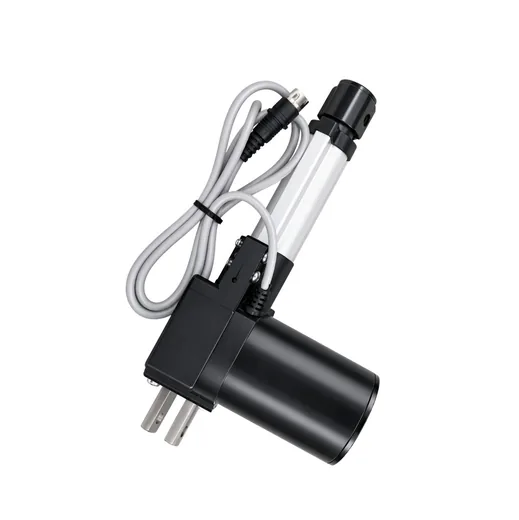
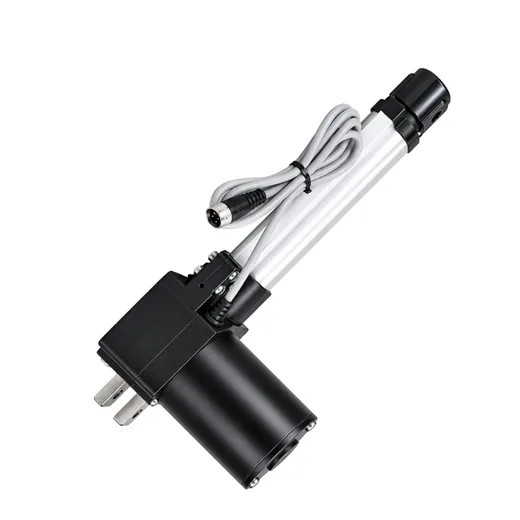
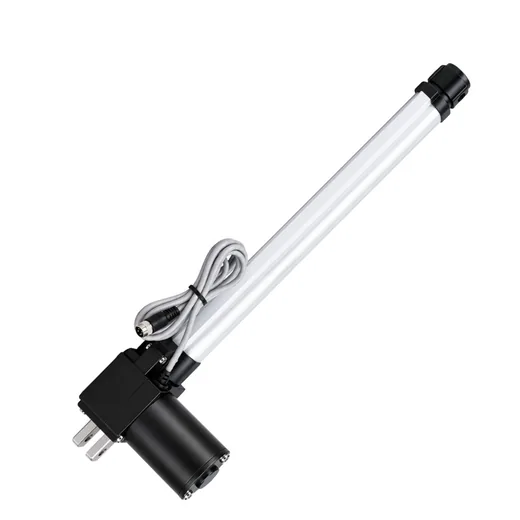
Products mentioned in this article
Made in Bengaluru. Click a product for full specifications, drawings and datasheets.
Frequently asked questions
How much extra force should I allow when choosing a linear actuator?
Choose a rated force about 25–30% above the calculated peak load. This covers friction, mounting angles and wear over the actuator's life.
Does an actuator run at its rated speed under full load?
No. Listed speeds are no-load speeds. Under full rated load the actuator runs slower, so allow some margin if the movement time is important.
Can I get a 12V linear actuator?
Purlin's listed models are 24VDC, and 12VDC configurations are available on request.
Related pages
Send us your load, stroke, speed and how often it moves. Our engineers in Bengaluru will recommend a model and send a quotation.
Send an inquiry


