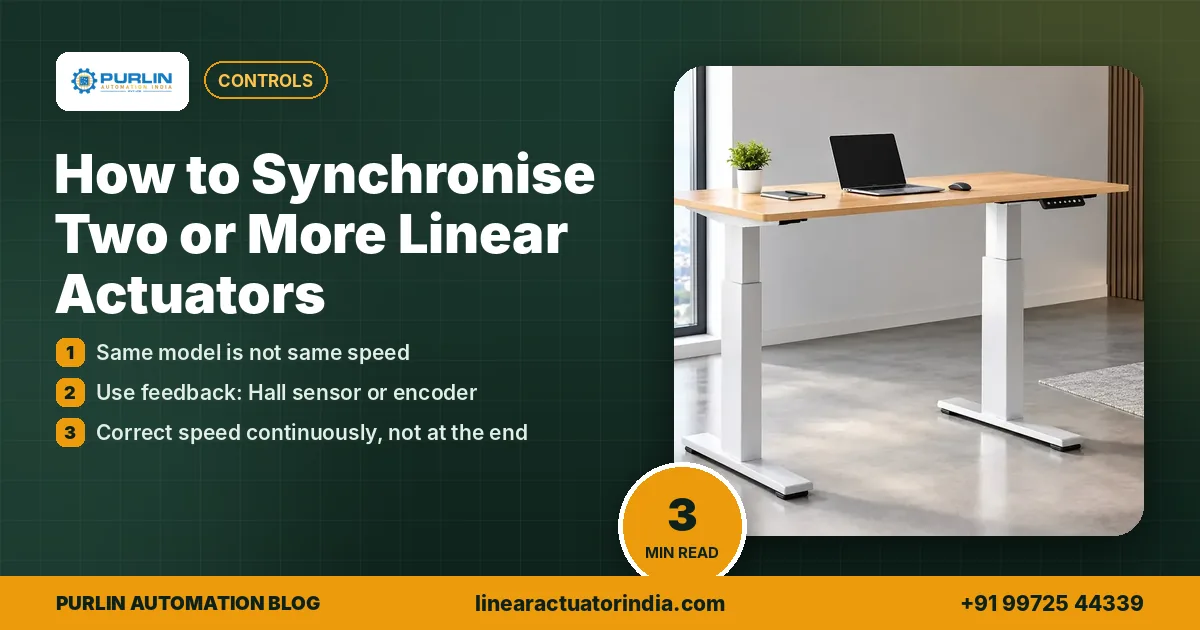
How to Synchronise Two or More Linear Actuators
Desks, beds, platforms and lifting tables often use two or more actuators to lift one load. Wire two identical actuators in parallel and they will still drift apart. Here is why, and how to keep them moving as one.
- Same model is not same speed
- Use feedback: Hall sensor or encoder
- Correct speed continuously, not at the end
Why identical actuators drift apart
Two actuators of the same model never run at exactly the same speed. Small differences add up:
- Motor-to-motor variation in speed and current
- Uneven loads, such as a person sitting on one side of a bed
- Different cable lengths and voltage drop
- Friction differences in gears and guides
A 2–3% speed difference sounds small. Over a 500 mm stroke, it can mean one side ends 10–15 mm higher than the other. That twists the frame, loads one actuator more than the other and, in a desk, makes the top tilt visibly.
Step 1: measure the position
Synchronisation needs feedback. Each actuator must report where it is. The common options are:
| Sensor | How it works | Good for |
|---|---|---|
| Hall-effect sensor | Counts motor shaft turns as pulses | Most synchronised systems: desks, beds, platforms |
| Optical encoder | Counts pulses from a slotted disc | Higher resolution positioning |
| Potentiometer | Gives a voltage proportional to position | Absolute position, simple analogue controllers |
Pulse sensors are relative: the controller must know a home position. That is why synchronised systems usually run all actuators to the fully retracted limit switch to "home" them after power-up.
Step 2: correct the speed continuously
With positions known, the controller compares them many times per second. If actuator A gets ahead of B, the controller slows A slightly (by reducing its PWM duty) or speeds up B. This is closed-loop control. The key is to correct during the movement, not to let them finish and then fix the difference.
A simple control approach for a microcontroller or PLC:
- Drive every actuator through its own H-bridge (direction plus PWM speed).
- Read each actuator's pulse count.
- Pick a target: the slowest actuator's position, or a common target that moves at a set speed.
- Reduce PWM on any actuator that is ahead, in proportion to the error (a proportional or PI controller).
- If the error grows past a safe limit, stop all actuators and report a fault.
The easy way: a synchronising control box
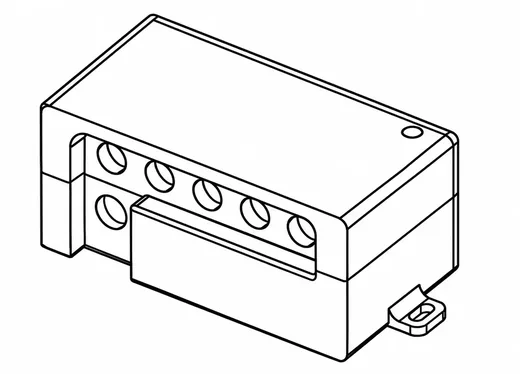
Writing and testing your own control is a real project. A ready-made synchronising control box does all of this, including homing, soft start and stop, overload detection and memory positions. Purlin control boxes synchronise two to six actuators and work with our hand controls and power supplies.
Practical tips
- Use the same model, stroke and production batch for all actuators in one system.
- Keep cable lengths equal, or use thicker cable on the longer run.
- Size each actuator for the worst-case uneven load, not the average.
- Make the frame stiff enough that small position differences do not twist it.
- Home the system regularly to clear any small counting errors.
Need a synchronised system?
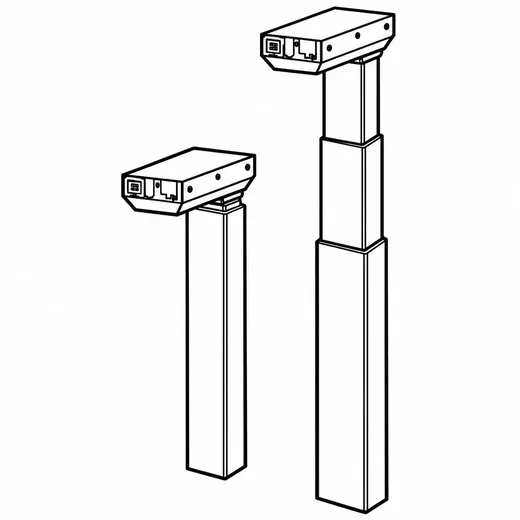
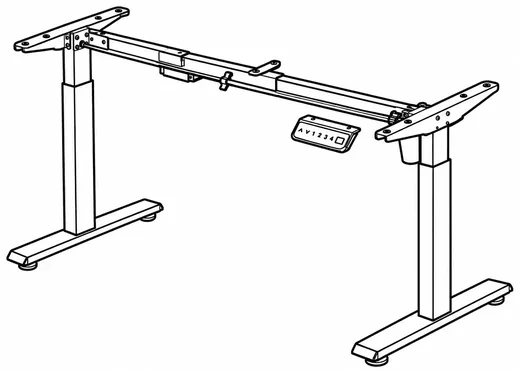
For desks and workstations, our height-adjustable desk kits and lifting columns come ready to run in sync. For custom machines, tell us how many actuators, the total load and the stroke, and we will suggest actuators and a matching control box.
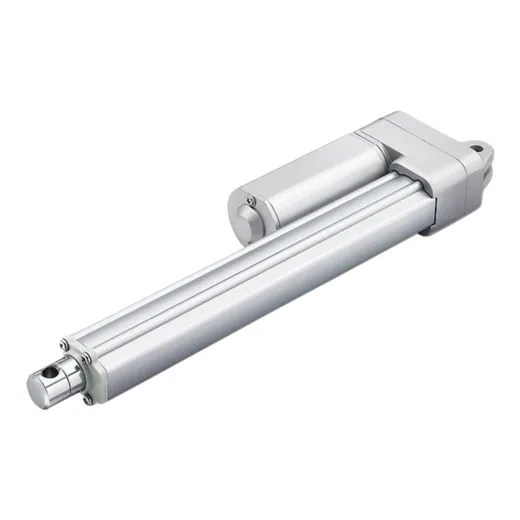
Products mentioned in this article
Made in Bengaluru. Click a product for full specifications, drawings and datasheets.
Frequently asked questions
Can I wire two linear actuators in parallel to keep them in sync?
They will move together roughly, but they will drift apart because no two motors run at exactly the same speed. Reliable synchronisation needs position feedback and a controller.
What sensor is used to synchronise linear actuators?
Most synchronised systems use Hall-effect sensors that count motor turns. Optical encoders and potentiometers are also used.
How many actuators can a control box synchronise?
Purlin control boxes synchronise two to six actuators.
Related pages
Send us your load, stroke, speed and how often it moves. Our engineers in Bengaluru will recommend a model and send a quotation.
Send an inquiry